The heat has arrived and the fan you have at home sounds like a plane taking off, or you don’t have one yet and don’t know where to start? Between pedestal, tower, table, ceiling, and endless decibel figures, it’s not as easy to navigate as it seems. Let’s work through how to pick the right one for you.
First things first: what type of fan do you need?
Pedestal fans (also called column fans) are the most common, well-known type: a pole holding up the blade cage, a cross-shaped base for stability, and adjustable height and tilt. They’re generally the most powerful and suited to cooling an entire room, while still being portable between rooms.
Tower fans have a compact vertical body with no visible blades: internally they use a turbine to generate airflow. They’re more modern in design, take up very little floor space, and — thanks to the spread of DC motors — are often quieter than traditional pedestal models.
Table fans are built for close, personal use: a desk, a nightstand, a kitchen counter. Compact and light, often USB-C powered, they’re the right choice if you only need to cool yourself, not an entire room.
Ceiling fans are less versatile — once installed, they stay put — but ideal for spots that never change: above a bed or dining table, where they distribute air better without taking up any floor or furniture space. Many modern models also offer a summer-winter function, reversing blade rotation to help distribute warm air in winter.
AC or DC motor: the difference that matters most
If you’ve already compared a couple of models, you’ve probably noticed the term “DC motor” showing up more and more, often at a higher price. Is it worth it? In most cases, yes. DC (direct current) motors offer three concrete advantages over traditional AC (alternating current) motors: they’re quieter for the same airflow, use 30-50% less power, and allow much finer speed control, often across 8, 10, or even 16 levels instead of the classic 3. If you plan to run the fan for many hours a day or at night, a DC motor pays for itself quickly in both comfort and electricity bills.
How quiet does it need to be
Noise is measured in decibels (dB) and is almost always listed in the spec sheet. Today a fan can be considered quiet between 20 and 35 dB, while values between 35 and 50 dB are average. Watch for a detail that often gets missed: the stated figure almost always refers to the lowest speed. If you plan to run it at full power often, check the figure at maximum speed too, which can be noticeably higher. If you need it for sleeping, check for a dedicated Sleep or Night mode, which gradually lowers the speed through the night.
Wattage, airflow, and oscillation
Wattage alone doesn’t tell you how powerful a fan really is. A table model can get by with 10-20 W, while a pedestal or tower fan meant for a whole room ranges from 30 up to 100 W. More useful than wattage is the stated airflow, expressed in m³/h or m³/min, and the throw distance in meters: these are far more direct indicators of real cooling capacity.
Finally, don’t underestimate oscillation: a fan that rotates on its axis distributes air across the whole room instead of blasting a single person. Basic models oscillate between 60° and 90°, more advanced ones reach 120° or beyond, some offering combined horizontal and vertical oscillation, often called 3D.
A few fans to get you oriented

The Rowenta Turbo Silence Extreme remains a benchmark for anyone after the best balance of power and quietness: 14 speed levels and just 32 dB(A) in Silent Night mode.
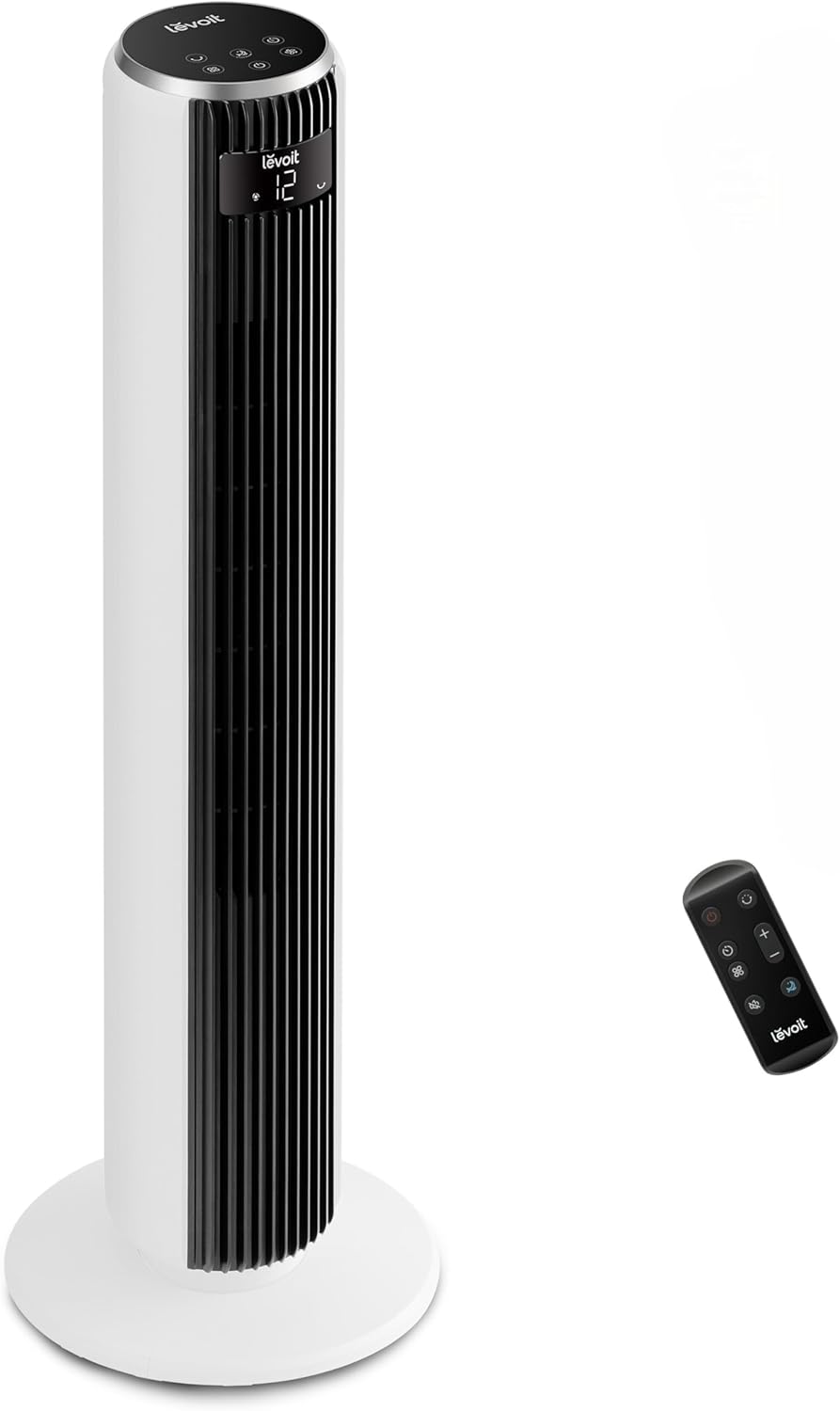
If absolute silence is priority number one, the Levoit 92cm drops to 20 dB thanks to Vortex Air technology, with a sleep mode that follows your rest phases.

The Midea FZ10-17JR is the most balanced choice between price, power, and features: LED display, remote control, and three operating modes at an affordable cost.

For anyone after a ceiling fan, the Cecotec Aero 4280 adds retractable blades and a built-in light fixture with three color temperatures.

If there are young kids or pets at home, the bladeless Pro Breeze OmniAir combines safety with a grade-13 HEPA filter to purify the air while it cools.
In summary
Always start from “where and how will I use it”: a desk calls for a table fan, a large living room a powerful pedestal or tower fan, a bedroom a quiet model with a DC motor and night mode. Wattage matters less than airflow, oscillation, and stated decibels: look at these three together, not one at a time.