Summer heat has arrived, you’ve decided a fan alone won’t cut it this year, but between BTU, SEER, single-split, multi-split, and no-outdoor-unit models you feel lost before you’ve even started searching. Let’s work through how to navigate it, step by step.
First question: how many BTU do you actually need
The most important figure to understand is BTU/h (British Thermal Unit per Hour): the higher it is, the greater the cooling capacity. As a quick reference: 9,000 BTU for small to medium-small rooms (15-25 m²), 12,000 BTU for standard rooms (25-40 m²), 18,000 BTU or more for large spaces or open plans.
For a more precise calculation, multiply the room’s volume (floor area times height in meters) by a coefficient between 85 and 100 BTU. If the result doesn’t match an available size exactly, always round up: a slightly oversized unit works less hard, while an undersized one will constantly run at full power, using more energy without truly cooling the room.
Single-split or multi-split: watch out for a common mistake
A single-split connects one indoor unit to an outdoor motor: the simplest solution, built for a single room. A multi-split (dual or trial) connects several indoor units to one outdoor motor, and this is where the most common mistake hides: a multi-split is designed to run one unit at a time. If you turn on two units simultaneously on a motor sized for a single 12,000 BTU room, the motor will struggle to serve both, run constantly at full power, and you’ll never get the comfort you’re after — and buying a bigger motor doesn’t fix it, because you’ll be running excess power whenever only one unit is on. If you need to cool multiple rooms at once, it’s almost always better to install several independent AC units, each sized to its own room.
With or without an outdoor unit
AC units without an outdoor unit (monobloc) pack every component — compressor included — into a single body mounted on a wall or floor, with just two small holes in an exterior wall for air exchange. They’re the right choice if you live in a historic center, a condo with architectural restrictions, or a rental where you can’t install an outdoor motor. The trade-off: since the compressor sits indoors, they’re generally louder than a classic split (often 40-60 dB) and, for the same capacity, cost more.
Fixed, portable, or evaporative cooler
A fixed AC unit, professionally installed, always remains the best-performing option: more efficient, quieter, and longer-lasting. A portable unit with a hose is the right call if you’re renting, can’t install ductwork, or need a temporary solution: it works with a real refrigerant circuit, but uses more power and is less convenient to move because of the exhaust hose. So-called ductless evaporative coolers (often loosely called “ductless portable air conditioners”) run on water and are cheaper and lighter, but lower the temperature much less: useful for personal cooling or small rooms, not as a substitute for a real air conditioner.
Inverter, heat pump, SEER, and SCOP
Inverter technology, now found on most modern AC units, continuously modulates power instead of constantly switching on and off: it uses less energy, lasts longer, and keeps the temperature more stable than the old ON-OFF models. The heat pump, also nearly universal today, lets you heat the room in winter as well as cool it in summer — very useful in the shoulder seasons, when you don’t yet want to switch on your main heating system.
On the energy label you’ll find two separate values if the unit has a heat pump: SEER (seasonal cooling efficiency) and SCOP (seasonal heating efficiency). The higher these values, the lower your real-world running costs throughout the year — far more informative than the A-G energy class alone.
A few units to get you oriented
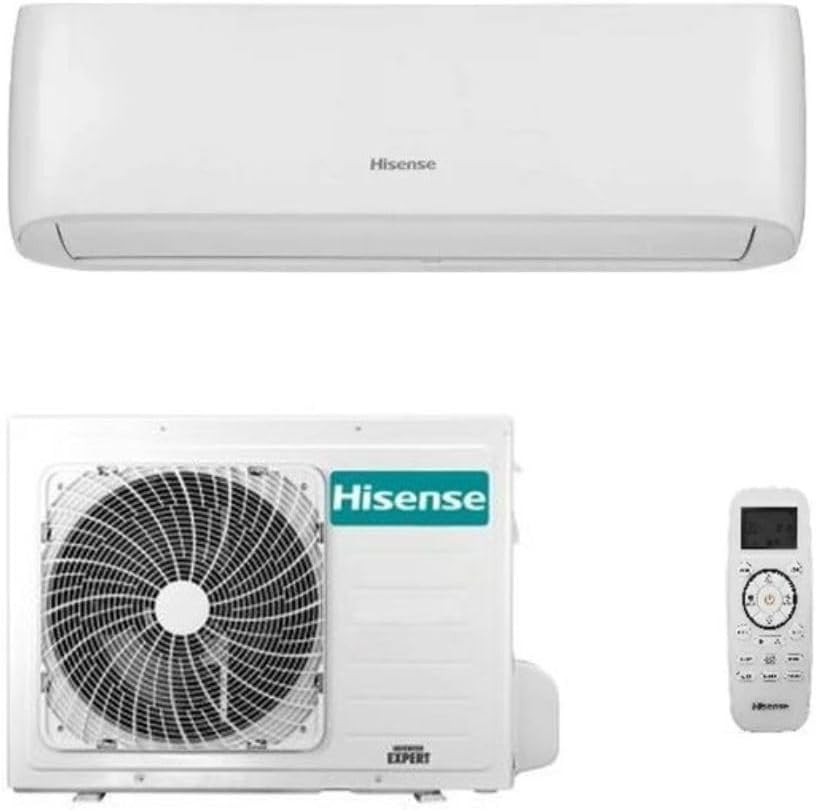
The Hisense Easy Smart Wifi is a solid starting point for a 12,000 BTU single-split: built-in Wi-Fi, A+++ class, and just 19 dB of noise.

The Daikin ATXF35E remains a benchmark for high-level efficiency and reliability, with consumption cut by up to 30% thanks to Inverter tech.

If you can’t install an outdoor unit, the Olimpia Splendid Unico Next 12 HP EVAN offers a complete 4-in-1 package with Wi-Fi and a silent mode down to 30 dB.

Among portables, the Dr.Prepare 9000 BTU stands out for its dehumidifying capacity (up to 24 liters a day) and smart Sleep mode.
In summary
Always start by calculating the BTU your room needs, then decide between fixed, no-outdoor-unit, or portable based on your home’s constraints — not the other way around. If you plan to use it in winter too, always check SCOP alongside SEER, and remember a multi-split only makes sense if you’ll run one unit at a time: for multiple rooms simultaneously, several independent units are the better call.